


Author’s note: Just between you and me, I’m a little tired of all the talk about gurus being “bad for you.” This certainly hasn’t been my experience. Yes, there are questionable characters, but my time with a Guru completely transformed my life — from selfish to selfless.
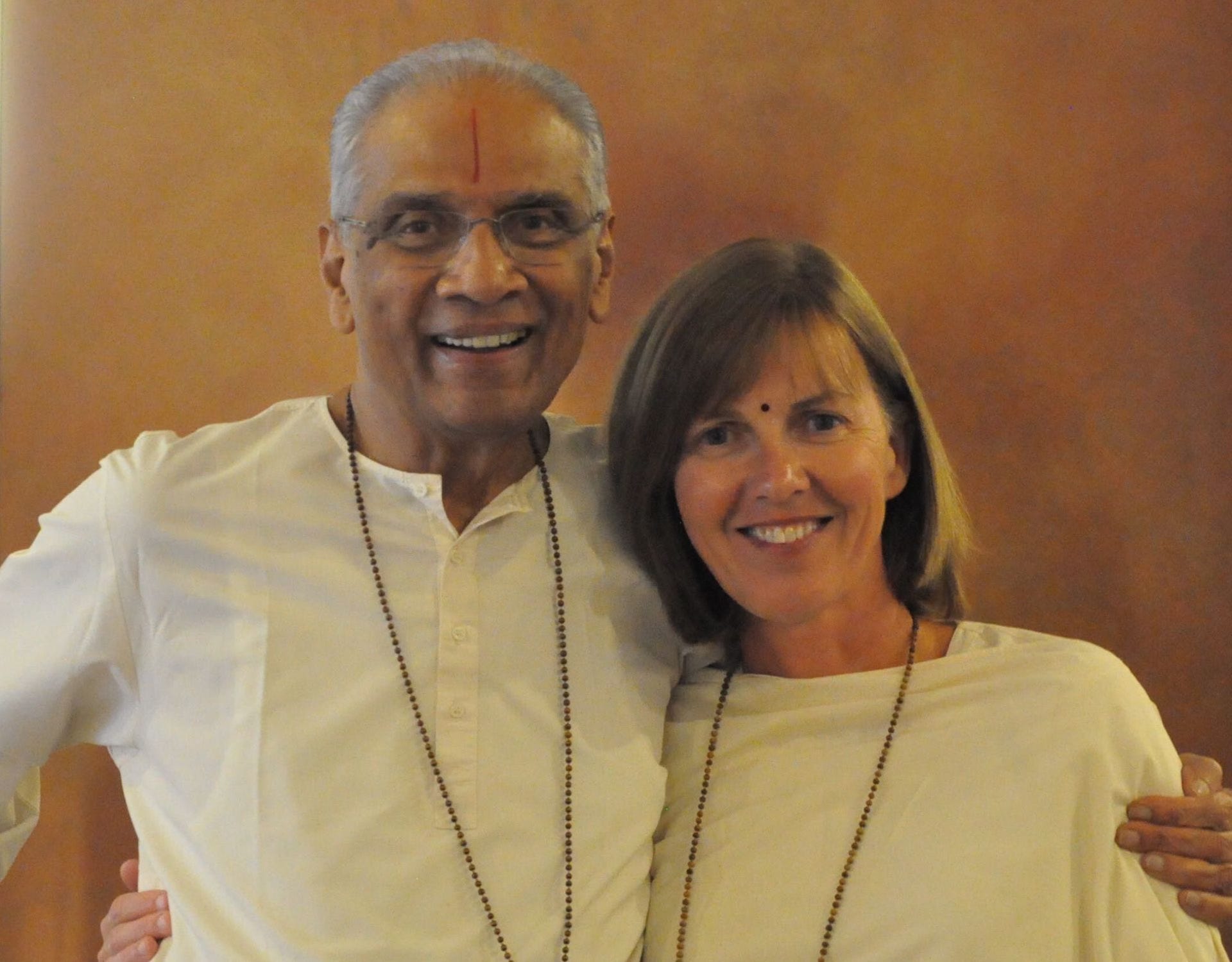
The hall was packed. Everyone wanted to see the Swami.1
Dressed all in white in a simple kurta and dhoti — with a mala around his neck and a red line on his forehead, signifying his spiritual status — he sat cross-legged on a raised platform on the stage.
His dignified presence commanded the room.
He closed his eyes, took in a deep breath, and chanted OM… The sound echoed throughout the auditorium, quietening the many minds seated before him.
In his talk, he spoke of the hollowness of human pursuits, saying that our lives are primarily driven by two motivations: acquisition and enjoyment.
“To feel happy,” he said, “you seek comforts and pleasures from the world, and then enjoy what you’ve acquired.”
He emphasised that there is nothing wrong with acquiring; there is no limit to what we may seek, as long as the starting point is contentment.
His words struck a chord. I wanted to learn more. And even though the hall was full, I felt as though he was speaking directly to me. They say that when the student is ready, the teacher appears — and I couldn’t have been more ready.
After the talk, I was introduced to Swamiji, who was incredibly humble and charming. I told him how much I had enjoyed his talk and that I was in awe of his book, Vedanta Treatise, which I had just begun reading.2
He listened as though there was no one else in the room. Then he told me about his academy in India, near Pune, and suggested I do the three-year residential course.
The seed was planted.
The Retreat
The retreat ran from Friday to Sunday and was held at Point Walter, overlooking the magnificent Swan River in Perth, Western Australia.
On Friday afternoon, we were welcomed by the organisers and shown to our rooms. Approximately forty people attended, including seven guests from India.
The evening lectures were open to the public, and the first talk was held that night.
As we walked into the hall, an Indian lady and a young Australian woman sat on the floor, chanting and singing Bhajans (Sanskrit songs). The hall slowly filled. The title of Swamiji’s talk was Bhaja Govindam: Seek The Self.
From what I understood, which was very little, knowing the Self would bring peace and happiness to my troubled mind, and I was troubled back then. On the outside, I was all smiles and shiny, but on the inside, I was like the matted coir of a coconut.
Swamiji entered and sat cross-legged on a raised platform on the stage. He paused. And at exactly six-thirty, he closed his eyes and chanted OM.
An exhilarating sense of calm filled the air.
He began by saying that all the stress and strain of life arises because the starting point is discontentment. Feeling empty within, so we try to fill ourselves with things, beings, and experiences. But as long as discontentment is the foundation, any amount of happiness we experience will only ever be temporary.
The message, therefore, was to seek the Self within, where permanent peace and happiness reside.
It was exactly what I needed to hear. Everything made sense. When we look for happiness outside, we may find it for a while, but it never lasts.
Throughout the retreat, there were talks by Swamiji, Q&A, yoga, music, meditative walks, joy, friendship and laughter. The retreat was designed to give a glimpse of life at the Vedanta Academy in India. It certainly whetted my appetite.3
Six weeks later, I was in India, studying Vedanta at The Academy.
That was thirty-three years ago.
What happened between then and now is another story for another time.
But what I will say is that the six years I spent in India under Swamiji’s guidance transformed my life. To be fair, it only took three years. But that’s three years. It’s a long time. So you can imagine how sceptical I am when people offer enlightenment in three days, or say their enlightenment came to them one night.
All they need is to be a smooth talker and have a good marketing team, and their career as a guru takes off. You know the ones I’m talking about.
And that’s one of the remarkable things about Swamiji. He doesn’t promote his work or seek publicity. Even finding information about him online is difficult because he doesn’t have a webpage. He does not even own a mobile phone!
His only interest was the spiritual growth of his students. He had all the wisdom. It was up to us to learn from him and apply the knowledge in our lives. Like a bird that teaches its fledglings to fly, he taught us well — and then set us free.
Thank you for reading. If you have any questions, please don’t hesitate to ask.
Till next time,
Be Well,
Meredith — The Elder Sage

"…it only took three years. But that’s three years. It’s a long time. So you can imagine how sceptical I am when people offer enlightenment in three days, or say their enlightenment came to them one night." --- indeed, it took years for universal wisdom to sink in, to really internalize, for it to become second nature and part of my thinking, and there was and still is a need for repetition and learning, because true insight appears in battle against our cognitive biases, and so we need to actively learn and discern every day.
This was such a beautiful read. Felt transported right to your retreat. And I’m so glad you brought this up. There are true Gurus. And they hold the keys to unlocking the truth within. Seeking their guidance is almost like a shortcut. Though you mentioned 3 years.. in the grand scheme, 3 years is very short 💜