


What if you were handed a manual for living on your first day of school? A blueprint for thinking clearly, loving selflessly, and standing tall in the face of life’s toughest challenges.
As you grew physically, you wouldn’t just gain bookish knowledge, you would mature mentally, so that you begin to see life AS IT IS, not as you would like it to be.
You wouldn’t feel bullied, anxious, or crumble under pressure, because you wouldn’t take yourself or the world too seriously.
The name of this manual is Vedanta.
Vedanta is an ancient philosophy that originated in the Himalayas over 10,000 years ago. It provides eternal principles for life and living.
These principles enable you to deal with life’s challenges in a calm and dignified manner. They teach you how to prepare for life’s eventualities; how to handle pressure, navigate pain, and rise when life knocks you down.
Above all, its philosophy leads you to the ultimate state of liberation: Moksha.
With the guidance this manual provides, you live the life you are meant to.
But, like most of us, it wasn’t like that for me.
I wasn’t handed any such manual. By the time the 1990s rolled around, I was 26 years old and completely adrift, like a small boat lost at sea, tossed and bossed by the chaotic winds of life.
While my friends were navigating the predictable milestones of their mid-twenties — settling into careers, getting married, buying homes, and starting families — I chose a path many labelled “radical and weird”.
I boarded a plane to India to “find myself”.
Shortly before, I had met a Swami in Perth during his Australian lecture tour. I read his book, Vedanta Treatise, and felt an inexplicable pull toward its concepts.1
While the world back home was spinning its usual wheels, I found myself cloistered in an Indian ashram under the brilliant guidance of a self-realised master, Swami A. Parthasarathy.2
For six years, I lived in the ashram, practised yoga, adopted a vegan lifestyle, and immersed myself in the study of this ancient philosophy — Vedanta.
What is Vedanta?
Vedanta is a Sanskrit word that literally means the end of knowledge. As radical as it sounds, once you know Vedanta, there is nothing more to be known.
It’s like this: Imagine you’re in a dream. While you're in it, you are bound by the rules of that dream — the sky, the people, the threats, the joys. But the moment you wake up, the dream world loses its power over you. You don’t need to analyse every detail of the dream to understand it; you simply realise its illusory nature.
Vedanta is like that. It’s the alarm clock. It takes you by the hand and leads you to the realisation of your original nature — your true Self.
Yet, unlike other mystical schools of thought that get lost in abstract ideas, Vedanta is intensely practical. It accepts the reality of our current human experience — that we function with a body, a mind, and intellect — and teaches us exactly how to navigate the messy day-to-day, guiding us step-by-step toward ultimate transcendence.
A Universal Philosophy
In contrast to most religions, Vedanta was not founded by a single prophet, messiah, or master. Instead, it was mapped out by a galaxy of anonymous sages and saints.
This gives Vedanta a uniquely universal edge. Its truths are timeless, not because one person declared them, but because generations of enlightened souls independently arrived at the same understanding and conclusions through disciplined living, reflection, and meditation.
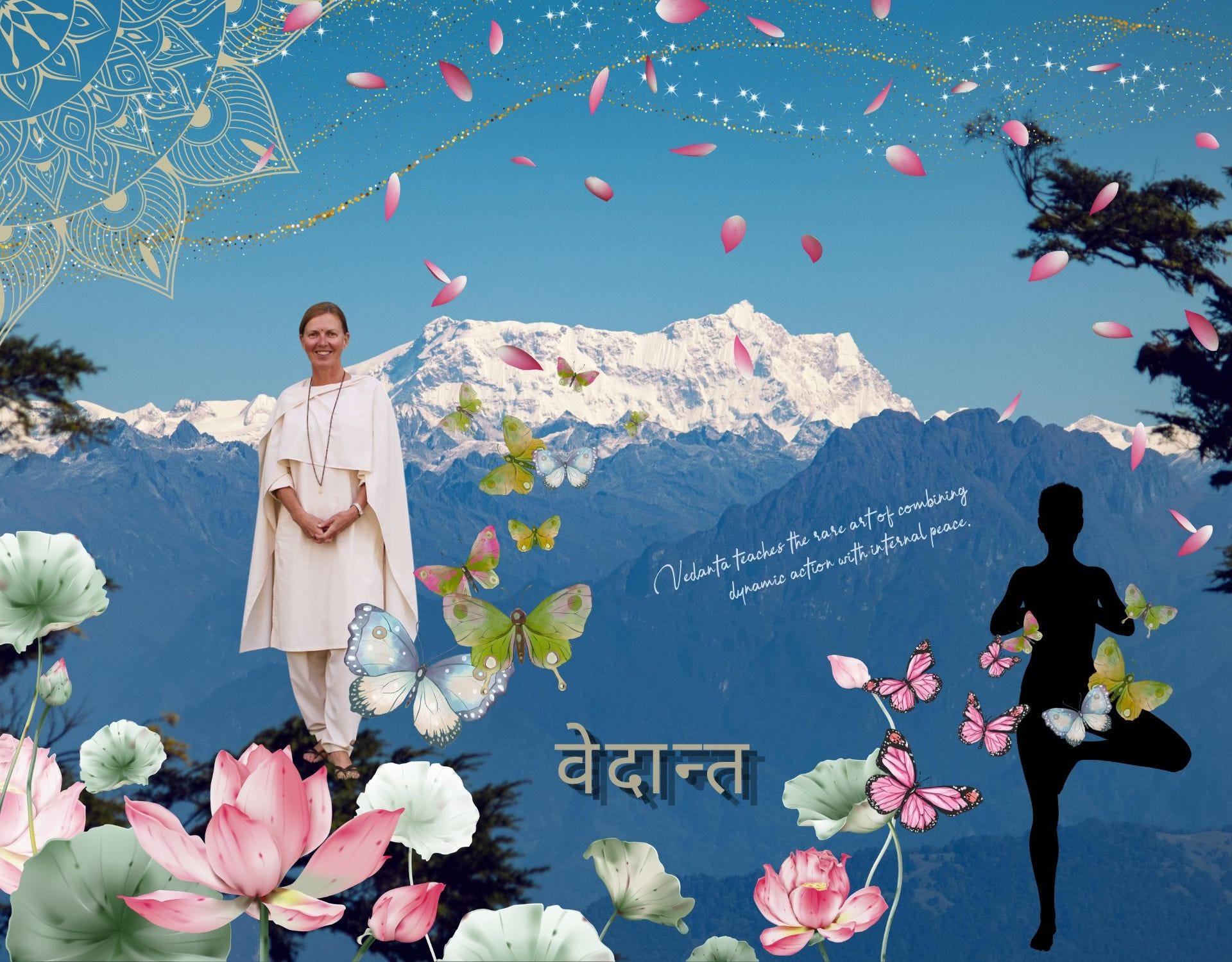
What makes Vedanta strikingly urgent today is that it teaches the rare art of combining dynamic, effective action with profound inner peace.
By instilling higher values and right action, Vedanta provides a blueprint for career success, business ethics, and domestic harmony. It guides you toward peace of mind amid action, rendering you completely unflappable, no matter what chaos swirls around you.
Why It Matters Today
Stepping onto that plane at 26 wasn’t a retreat from the world; it was a deep dive into the very mechanics of how to live in it.
Today’s world is louder, faster, and people are more fearful and anxious than ever before.
Vedanta matters today because it reminds us that the quality of our lives is never determined by our bank accounts, our resumes, or our social status, but by the clarity of our internal state.
Looking back at those six years in the ashram, I realise that the timeless principles I studied under Swamiji are not just concepts in a book. They are the anchor of my existence.
They are living proof that the ancient past still holds the brightest key to our chaotic present — and they are the only manual you need for a truly peaceful future.
Thank you for reading.
Till next time,
Be Well,
Meredith ♾️ The Elder Sage
I'm so glad substack has the voice section. The article feels more real and human. Thanks for this :)
Could use some of the teachings of this in high schools I think!