


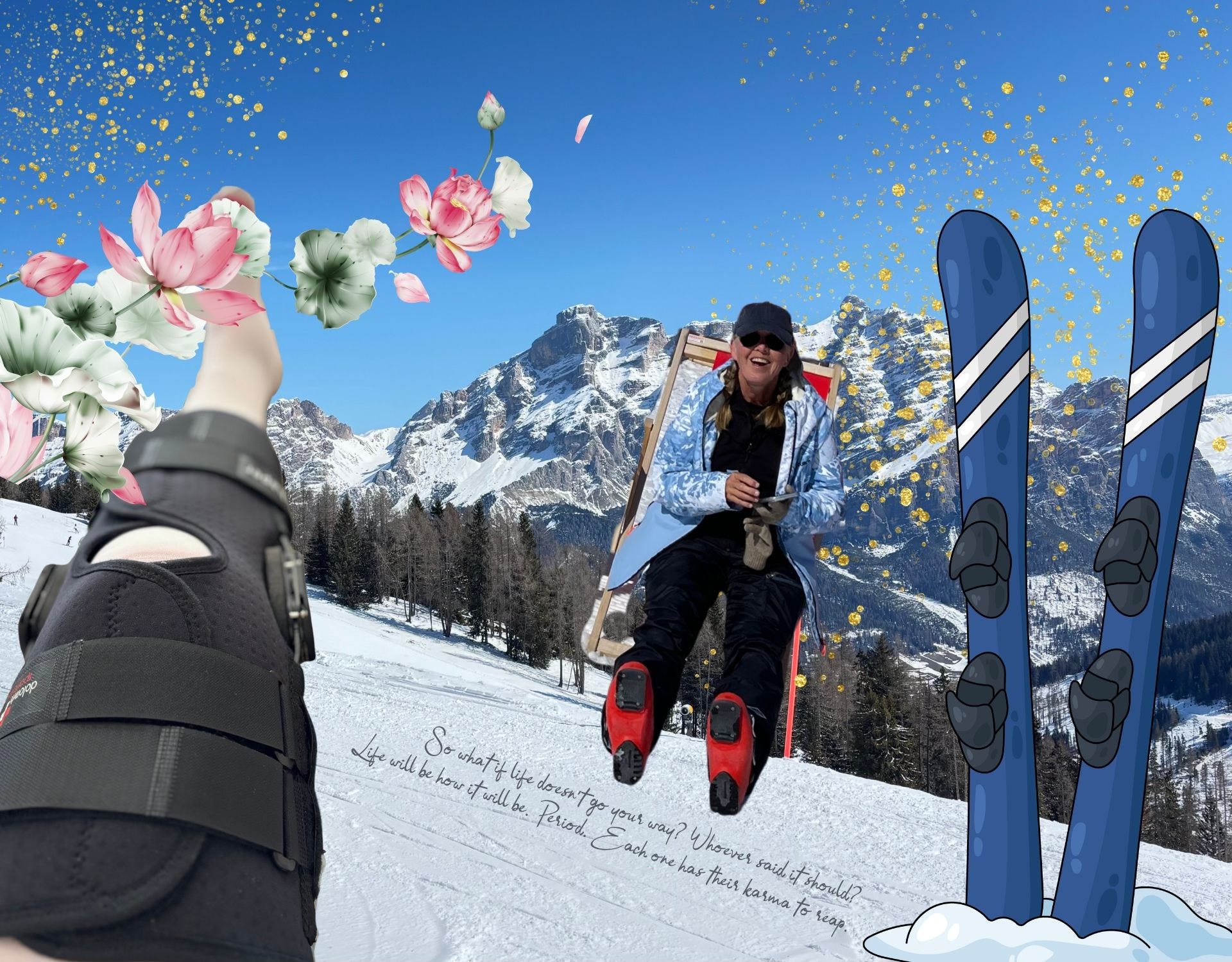
In a single second, life can turn completely upside down — and show you what you’re really made of.
It began just over a week ago, on Good Friday. My husband and I had just spent ten glorious days skiing in Corvara, Alta Badia, celebrating our 25th wedding anniversary — a long-awaited gift to ourselves. Everything felt effortless. Light. Perfect.
We were having a ball. By the end of our ten days, I had proudly skied 15 slopes (24 km) in a day. Not bad.
But then, in an instant, everything changed.
I fell.
I’d fallen before, quite spectacularly, I’ve got to say, and walked away with nothing more than bruises. But this was different.
Before I explain the fall, there’s something worth mentioning.
This was an extra day of skiing. An unplanned indulgence — like a dab of wasabi: exciting in the moment, but a second later you’re questioning why you ever thought it was a good idea.
And, as it turns out, it wasn’t a good idea. But more about that later.
Back to the fall.
The slopes were new. We were now in Plan de Gralba in Val Gardena. I’m an intermediate skier; Paul is advanced. He enjoys the steep runs, but I don’t. I prefer control and predictability — solid ground beneath my feet. Not ideal for skiing, but I’ve never been one to take too many risks. I always prefer to err on the side of caution.
From Paul’s perspective, I had improved out of sight. He had no doubt about my ability to handle the steeper slopes.
So we took the lift to the top.
Standing there, looking down, he pointed out the blue runs — the ones within my comfort zone. But to reach them, I had to traverse a short red run.
He skied ahead a few metres down the slope and waited.
“Come on,” he said. “You can do it.”
I hesitated. A subtle tightening inside — the kind you cannot afford on a ski slope.
He waited. But I could sense his impatience.
So I pushed off.
One turn. Then another.
And then I was down.
“Ouch.”
I raised my arm. “I’ve hurt my knee.”
“No, you haven’t,” I heard him say.
Yes, I have!” I yelled.
A paramedic was at my side within moments.
“Are you okay?” He said.
“No. I need help.”
Another paramedic arrived. They helped me to my feet and checked whether I could stand. My knee felt very unstable.
“I can’t ski,” I said.
So they brought a snowmobile and carried me down.
Strangely, I wasn’t in much pain. I simply enjoyed the ride. This is something I’ve learnt through Vedanta: to meet each moment as it comes and to find the good in it — even in adversity.1
So that’s what I did. I breathed in the mountain air. I spoke to the paramedics in my broken Italian. We laughed. They sympathised. They were kind, gentle, and unhurried.
Since studying Vedanta, I’ve come to see that the best and worst of life are simply experiences. They come and go. Nothing stays long enough to justify losing your balance.
Everything passes. Including this.
There’s a beautiful Sanskrit word called Titiksha, which is the capacity to endure difficulty with grace. To meet discomfort without agitation.
A beautiful quality worth cultivating.
“In the midst of winter, I learned that within me there is an invincible summer.”
Albert Camus
The next thing to happen was that Paul picked up the car and drove me to the doctor. I watched the mountains pass by, still calm, still at ease.
While driving, he said, almost casually, “Don’t be alarmed, but I don’t think we’re insured for today.”
I said, “It’ll be fine. We’re with RAC. They’ll look after us.”
(We had ski insurance for ten days, not eleven.)
The doctor saw me immediately. X-rays were taken, and he explained that “My left knee was like a jelly pudding.” But to understand the full extent of the damage, I needed an MRI, which meant travelling to another clinic.
So we went.
If you’ve never had an MRI, it’s a strange experience. Fifteen minutes of absolute stillness — not even a twitch was allowed. And the noise was deafening. Mechanical and relentless. Yet, despite it all, the process was seamless.
I couldn’t help but admire the Italian system, especially the ethos of the Dolomiti Sports Clinic, which is designed specifically for ski injuries and where diagnosis and surgery occur with remarkable speed.
But the results were grim. Two cruciate ligaments were torn, and the meniscus was badly damaged. In essence, a full knee reconstruction was necessary.
I could have gone into surgery that evening, but Paul wanted to confirm the insurance coverage first. It was going to be an expensive operation.
But confirming cover proved complicated. It was Easter. In Australia, everything shuts down. Still, there was an emergency line, and Paul managed to reach someone in America. No one mentioned the dates, so it all seemed fine to proceed. Still, there was no confirmation from Australia. Which meant one thing: we would have to pay up front.
The doctors were clear — this kind of injury required immediate surgery. Waiting until we returned to Australia, despite having private healthcare, wasn’t advisable.
So on Saturday, Paul paid the €15,000 bill, and I went in for surgery.
The two-hour operation was like a comma in a sentence — barely a pause. One moment, I was there, being prepared. The next, it was over.
On Easter Sunday, I met Tao, the physiotherapist. She was from Georgia, just thirty years old, bright and full of warmth.
“I like your pants,” she said.
“They’re from India,” I replied — and just like that, a conversation began.
I told her I had lived in India for six years, and had returned many times since. She was intrigued.
“What were you doing there?”
“Studying philosophy.”
“Really? What kind?”
“Vedanta.”
For me, meeting someone genuinely interested in Vedanta is rare — and deeply satisfying. We spoke for two hours about human nature and small miracles, as we worked through the therapy.
At one point, I smiled and said, “I’m almost certain I had this accident just to meet you.”
After physio, I was allowed back to the hotel, where I continued to rest.
On Easter Monday, we had to leave and head back to Venice. But before we left, Paul got some bad news.
“They’re not paying,” he said.
RAC travel insurance had confirmed that the ski portion of our holiday was covered only until April 2nd. The accident happened on April 3rd, Good Friday.
One day.
That was all it took.
I had believed they would assist. After all, that was their job. That’s what we paid them for. Instead, we found ourselves on our own — injured, overseas, and paying for everything.
But I don’t say this to complain. The mistake was ours, and we take full responsibility. Yet, to have our claim denied and be cut off from any assistance — to have no discussion. No exception. No help was a genuine blow.
We both felt flat — for a moment. But we decided to put it behind us and keep moving forward. We had a drive ahead of us to Venice, and that required all our focus.
So we drove. Forgetting the past, not concerned about the future. Our full attention was on the road. Consequently, we enjoyed the road trip immensely.
I should mention that the emergency organisation working on behalf of RAC was exceptional. Human, responsive, and genuinely helpful. They arranged flight options for us, including upgrades so I could lie flat, and even lodged a complaint to RAC on our behalf.
Venice was another adventure. It’s a city with no cars — just vaporettos (water buses), water taxis and gondolas. You have to walk to get anywhere. This was our third visit, so it didn’t bother me that I would have to stay mostly in the hotel. I saw it as an opportunity for rehabilitation.
So, we dropped the rental car at the airport and took a water taxi into the city. I was slightly apprehensive; it meant being carefully lowered into the boat. But it was all good.
It was a beautiful day. And a fabulous way to arrive in Venice.
Finally, in the hotel room, Paul and I breathed a sigh of relief.
What an ordeal.
And yet… here we were.
In Venice.
On crutches, unable to go far — but still, incredibly happy.
The flights arranged for us were long and indirect, avoiding certain regions. But we discovered a shorter route via Dubai — Venice to Dubai, then onto Perth. With a ceasefire in place and reassurance from friends in Dubai, we felt comfortable choosing that option.
So that’s how we travelled home.
And as I sit with it all — the fall, the surgery, the cost, the uncertainty — I’m reminded of something simple.
Life is a flow of experiences. Some we welcome. Others we would never choose. And in that moment, we have a choice: to resist or to accept, to collapse or to remain steady.
We may not control what happens to us, but we do have a say in how we respond.
That is where our freedom lies.
Everything passes. The best of things and the worst. So why not meet each experience with a little grace?
Thank you for reading. I hope you enjoyed this story as much as I did writing it for you. If you have any questions or anything you’d like to say, feel free to write them in the comments.
Until next time,
Be Well,
Meredith, The Elder Sage
Become a Valued Patron
Benefactors unlock the secrets to:
What No One Tells You About Happiness
The Real Reason You’re Not Happy
What Keeps You from Happiness
And More ...
Vedanta is the ancient philosophy of India. It is the philosophy of the Vedas and the Bhagavad Gita. Vedanta Treatise is the book that changed my life.
Wow it all sounds so painful to me, and such a traumatic injury, only you can write such a positive & inspiring story in relation to your Fall - i am so happy to hear that you are back home, have had immediate surgery in Italy, now with Autumn here, you can focus on recovering in your beautiful place of the world - Italy sounds wonderful, also how they took care of you - good to hear that you remained happy to enjoy the rest of your holiday - may their not be too much knee pain in your recovery journey, and may you heal well - i do hope their will be some $ re-imbursement from your surgery, all the best always meredith x:_)x
I very much enjoyed this post Meredith. Thank you for sharing this story!
This too, shall pass 🙏